
How Many Attempts for UPSC 2027? Category-Wise Attempt Limits
Akshay
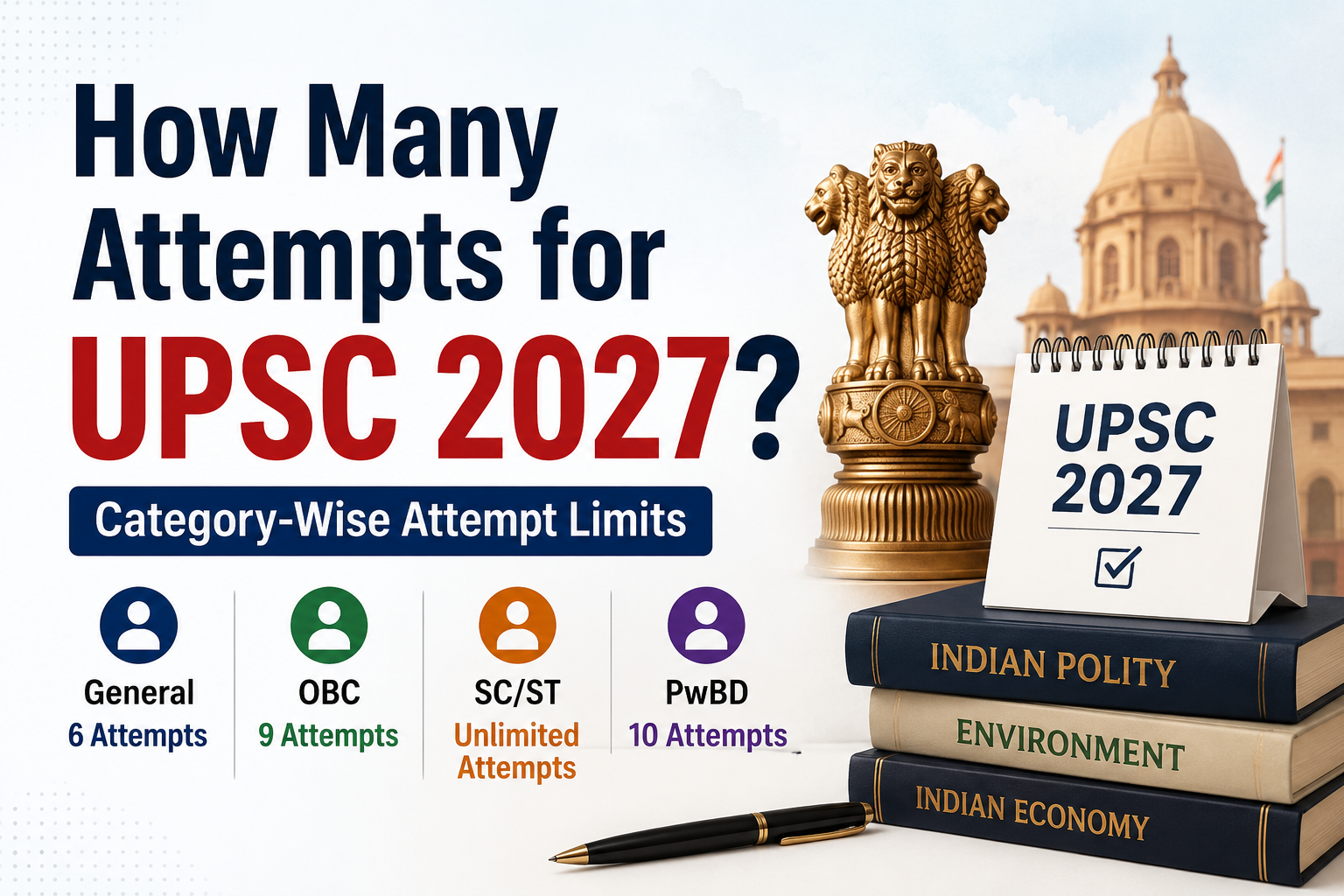
If you are planning to sit for the UPSC Civil Services Examination (CSE) 2027, one of the very first questions you need answered isn't about the syllabus or the toughest optional subject, it's simpler and more urgent: how many attempts do you actually get? Get this wrong and you could either burn a precious attempt too early or, worse, disqualify yourself from applying at all. This guide breaks down the UPSC 2027 attempt limits category by category, explains exactly how an 'attempt' is counted, and clears up the myths that trip up thousands of aspirants every year.
What Exactly Counts as 'One Attempt' in UPSC?
This is where most first-time aspirants get confused. An attempt is not counted when you fill the online application form. It is not counted when you download your admit card. UPSC counts an attempt only when you physically appear in at least one paper of the Civil Services Preliminary Examination.
• If you apply but skip Prelims entirely, it does NOT count as an attempt.
• If you appear for even one paper of Prelims Paper I or Paper II and leave, it DOES count as a full attempt.
• Submitting a blank answer sheet still counts, because you were physically present and entered a response, even a blank one.
• Being disqualified mid-exam for a rules violation still counts as an attempt, since you appeared.
• Your performance in Mains or the Interview has no bearing on whether an attempt is 'used up' the count is locked in at the Prelims stage itself.
This distinction matters enormously for strategy. Many aspirants who fall sick or feel underprepared skip Prelims deliberately, precisely so that the year does not eat into their limited attempt count.
Category-Wise Attempt Limits Explained in Detail
1. General Category 6 Attempts
Candidates in the unreserved General category get six attempts at the UPSC CSE, and they must clear the exam before turning 32 (as on 1 August of the exam year). There is no attempt relaxation and no age relaxation for General candidates under normal circumstances. This is the strictest of all categories, which is exactly why General candidates are advised to plan their attempt sequence carefully rather than treating early attempts as casual 'practice runs.'
2. EWS (Economically Weaker Section) 6 Attempts
A common misconception is that EWS candidates get extra attempts or age relaxation, similar to OBC or SC/ST. They do not. EWS status only reserves a percentage of vacancies for economically weaker candidates from categories that are otherwise unreserved; it does not change the attempt or age framework in any way. EWS candidates follow exactly the same 6-attempt, 32-year rule as General candidates.
3. OBC Non-Creamy Layer 9 Attempts
Other Backward Classes candidates who fall in the Non-Creamy Layer (NCL) meaning their family income and status fall below the government-prescribed 'creamy layer' threshold get nine attempts and a three-year age relaxation, taking their upper age limit to 35 years. This relaxation applies only with a valid, current OBC-NCL certificate issued in the prescribed format. If your OBC certificate has expired or you fall in the creamy layer, UPSC treats you as a General category candidate for both attempts and age a detail that catches out a surprising number of candidates every year.
4. SC and ST Unlimited Attempts
Scheduled Caste and Scheduled Tribe candidates face no cap on the number of attempts whatsoever. They can appear for the UPSC CSE every single year as long as they remain within the prescribed upper age limit of 37 years. This is the single biggest advantage of the SC/ST attempt structure age, not attempt count, becomes the only real constraint. It also means SC/ST candidates need a different kind of strategic thinking: since attempts are not scarce, the real decision each year is whether that particular year's preparation level justifies appearing at all, rather than whether an attempt can be 'afforded.'
5. PwBD (Persons with Benchmark Disabilities) Extra Attempts and Age Relaxation
Candidates with benchmark disabilities recognized under the Rights of Persons with Disabilities Act receive additional relaxation layered on top of their base category. PwBD candidates from General, EWS, or OBC backgrounds get nine attempts and an upper age limit of 42 years. PwBD candidates from SC or ST backgrounds get unlimited attempts, also up to age 42. This combination of disability relaxation and category relaxation is cumulative, which is why PwBD SC/ST candidates end up with the most generous eligibility window of any group.
6. Defence Personnel and Ex-Servicemen
UPSC also provides age relaxation not attempt relaxation for two specific groups connected to the armed forces. Defence Service personnel disabled in action during hostilities with a foreign country or in a disturbed area get a three-year age relaxation over their base category limit. Ex-servicemen, including Commissioned Officers and ECOs/SSCOs who have rendered at least five years of military service, get a five-year age relaxation. In both cases, the number of attempts allowed still follows the candidate's underlying category (General, OBC, SC, or ST) only the upper age ceiling is extended.
Age Limit vs Attempt Limit: Why the Two Are Not the Same Thing
One of the most important things to internalize about UPSC eligibility is that age limit and attempt limit are two separate, independent constraints you must satisfy both, not just one. An SC candidate technically has unlimited attempts, but that does not mean they can appear forever; they still lose eligibility the moment they cross 37 years of age. Similarly, a General category candidate who is only 25 years old but has already used all six attempts cannot appear again, even though they are well within the age limit.
Think of it as two separate doors that both have to stay open. Whichever door closes first age or attempts ends your eligibility for that category. This is exactly why aspirants are advised to map out their attempt-and-age timeline at the very start of their preparation journey, not somewhere in the middle of it.
How Attempts Are Calculated as on 1 August 2027
UPSC fixes a single cut-off date for calculating age eligibility 1 August of the examination year. For CSE 2027, that means your age is calculated exactly as on 1 August 2027, regardless of when you apply or when Prelims is actually held. For General and EWS candidates, this translates to a date-of-birth window roughly between 2 August 1995 and 1 August 2006. OBC candidates get an additional three years on the upper end, and SC/ST candidates get an additional five years over the General limit. It is worth stressing that these figures are the expected pattern carried forward from CSE 2026 and prior years; the exact dates will be confirmed only when the CSE 2027 notification is officially published.
Common Myths About UPSC Attempts Busted
• Myth: Applying for the exam counts as an attempt even if you skip Prelims. Fact: it does not only physical appearance in a Prelims paper counts.
• Myth: EWS candidates get relaxed attempts like OBC. Fact: EWS follows the exact same rules as General on both attempts and age.
• Myth: Creamy-layer OBC candidates still get 9 attempts. Fact: they are treated as General category and get only 6.
• Myth: If you clear Prelims but skip Mains, the attempt doesn't count. Fact: the attempt is locked in at Prelims itself, irrespective of what happens afterward.
• Myth: SC/ST candidates can appear at any age. Fact: they must still stay within the 37-year upper age limit.
• Myth: Attempt limits and age limits will definitely change for 2027. Fact: as of now there is no official notification confirming any change; treat rumors on social media as unverified until UPSC's gazette notification confirms otherwise.
How Many Attempts Should You Actually Use? A Strategic View
Having six or nine attempts on paper does not mean you should treat every one of them as disposable. Most successful candidates clear the exam within their first three attempts, and data across recent years shows a clear pattern: preparation quality and consistent revision matter far more than the number of attempts available. A candidate who appears underprepared purely to 'get exam experience' is often making a costlier trade than they realize, especially in the General and EWS categories where attempts are scarce.
A more useful way to think about your attempts is as a limited but renewable budget. Set yourself a realistic target for instance, aim to be fully exam-ready by your second attempt rather than your fourth and use each attempt as a genuine test of a specific preparation strategy rather than a routine formality. For SC and ST candidates, since attempts are unlimited, the more relevant discipline is managing the age window efficiently and avoiding years where preparation is genuinely inadequate.
Documents and Certificates You'll Need to Claim Category Benefits
• OBC candidates: a current Non-Creamy Layer certificate issued within the validity period prescribed by UPSC (typically issued or revalidated within the preceding financial year).
• SC/ST candidates: caste certificate issued by a competent authority in the prescribed format.
• EWS candidates: EWS certificate issued in the current financial year, confirming income and asset criteria.
• PwBD candidates: disability certificate confirming benchmark disability status as defined under the RPwD Act, along with category-specific certificates where applicable.
• Ex-servicemen/Defence personnel: discharge certificate or equivalent service documentation proving the required years of service or combat-related disability.
Keep digital and physical copies of all relevant certificates ready well before the application window opens. A missing or expired certificate at the document verification stage can retroactively affect how your category and therefore your attempt count is treated, even after you've successfully appeared for the exam.
Frequently Asked Questions
Q1. How many attempts are allowed for General category candidates in UPSC 2027?
General category candidates get 6 attempts, and they must clear all attempts before turning 32 years of age as on 1 August 2027.
Q2. Do EWS candidates get more attempts than the General category?
No. EWS candidates follow the exact same rule as General category 6 attempts, upper age limit of 32 years. EWS only affects vacancy reservation, not eligibility limits.
Q3. How many attempts does the OBC category get in UPSC 2027?
OBC (Non-Creamy Layer) candidates get 9 attempts, with an upper age limit of 35 years, provided they hold a valid NCL certificate.
Q4. Is there really no limit on attempts for SC and ST candidates?
Correct SC and ST candidates have unlimited attempts. Their only constraint is the upper age limit of 37 years as on 1 August 2027.
Q5. Does appearing in only one paper of Prelims count as a full attempt?
Yes. UPSC counts an attempt the moment a candidate appears in even one paper of the Preliminary Examination, regardless of how the rest of the exam goes.
Q6. Can OBC candidates in the creamy layer claim 9 attempts?
No. Creamy-layer OBC candidates are treated as General category candidates and are limited to 6 attempts and the 32-year age ceiling.
Q7. How many attempts do PwBD candidates get?
PwBD candidates from General, EWS, or OBC backgrounds get 9 attempts with an upper age limit of 42 years. PwBD candidates from SC/ST backgrounds get unlimited attempts, also up to 42 years.
Q8. When will the official UPSC CSE 2027 notification be released?
UPSC typically releases the CSE notification in February each year. The CSE 2027 notification is expected around February 2027, and it will confirm the final, official attempt and age limits for that cycle.
Conclusion
Knowing your exact attempt and age limits isn't just an eligibility formality, it's the foundation your entire UPSC strategy should be built on. Whether you have 6 attempts, 9 attempts, or an unlimited window, the real difference between candidates who succeed and those who don't rarely comes down to how many chances they had. It comes down to how deliberately each attempt was used.
At PrepCat, we help UPSC aspirants turn this kind of eligibility clarity into an actual preparation plan from structuring your attempt-by-attempt strategy and building a realistic study timeline, to tracking your syllabus, revision cycles, and mock test performance in one place. If you're gearing up for UPSC 2027, don't just count your attempts make each one count. Explore how PrepCat can help you plan smarter and prepare with confidence for the attempts that matter most.