
Soils of India: Formation, Types and Conservation — Revision Guide
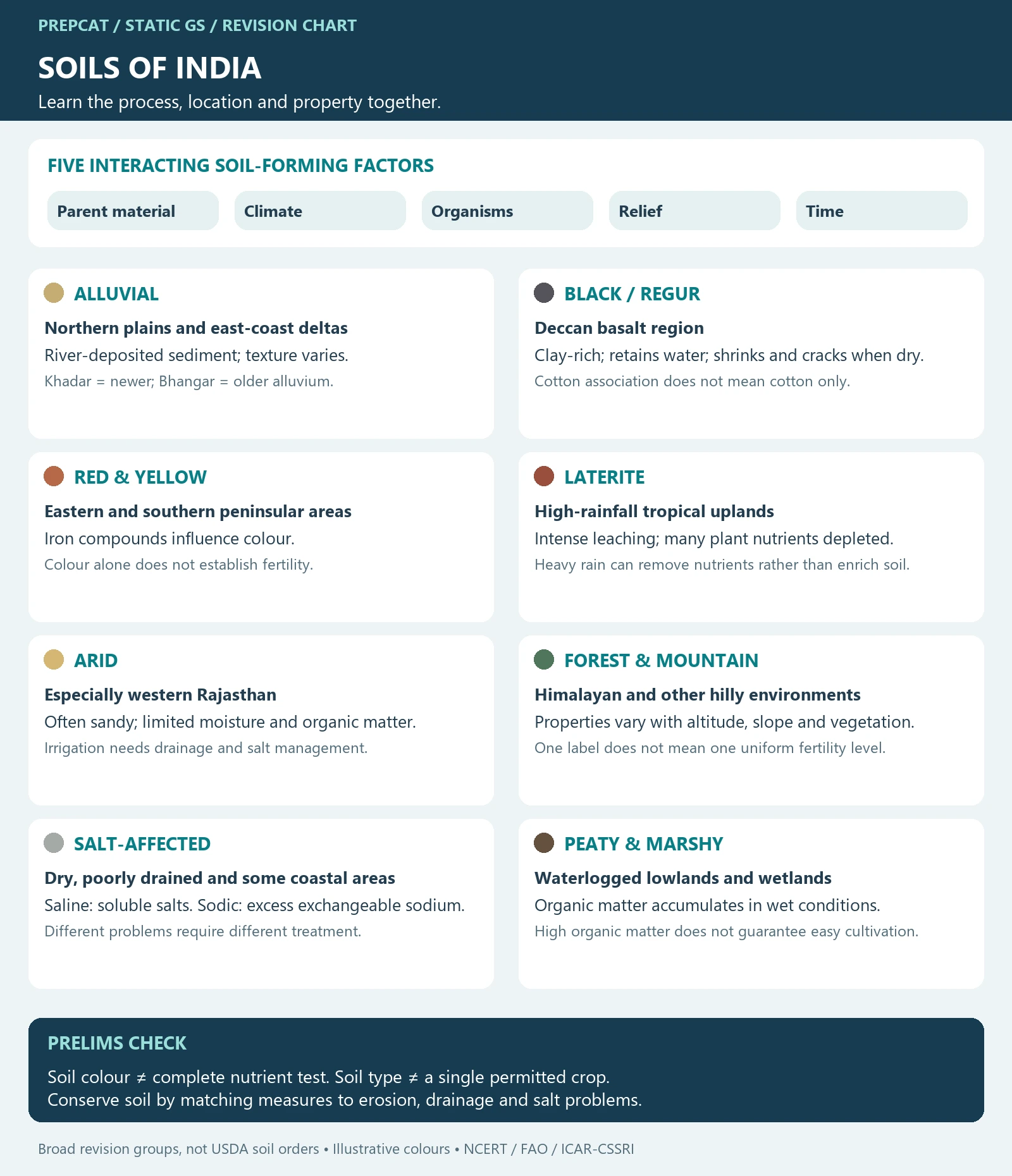
Five interacting soil-forming factors and the difference between texture, structure and fertility.
Eight broad soil groups with formation, distribution and revision clues.
Khadar versus Bhangar; saline versus sodic; conservation matched to the problem.
📌 Revision Pointers
Formation: Parent material + climate + organisms + relief + time.
Alluvial: Khadar is newer; Bhangar is older.
Black soil: Clay-rich and moisture-retentive; shrink–swell behaviour.
Laterite: Intense leaching; high rainfall does not guarantee high fertility.
Salt-affected: Salinity and sodicity require different diagnoses.
Conservation: Match erosion control, drainage and chemical reclamation to the actual problem.
Soil: A Living System at the Earth’s Surface
Soil contains mineral particles, organic matter, water, air and organisms. It anchors plants, cycles nutrients and influences how water enters and moves through the ground. A soil is more than crushed rock: biological activity and changes over time create properties that differ from the original material.
Formation: Parent material, climate, organisms, relief and time interact. Weathering supplies mineral material; roots and decomposers contribute to organic-matter cycling. Slope affects drainage and erosion. Parent material may be weathered rock in place or sediment transported by rivers, wind or ice. The same rock can develop different soils under different climates.
Source: FAO: soil-forming processes; USDA-NRCS: what soil is.
How to Read a Soil Description
Texture refers to the proportions of sand, silt and clay. Structure concerns how particles are arranged into aggregates. Fertility concerns supplying nutrients; it is not identical to texture or colour. Crop performance also depends on water, drainage, climate and management. A dark soil is not automatically rich in every nutrient.
Major Soil Groups of India
The chart uses broad conventional groups for revision. They are not a one-to-one list of scientific soil-taxonomy orders. Distribution below is indicative: each state contains local variation.
Alluvial: River-deposited soils of the northern plains, valleys and many east-coast deltas. Their texture varies. Khadar is newer alluvium; Bhangar is older. Alluvial regions support cereals and other crops, but local drainage and nutrients still matter.
Black or regur: Associated especially with the Deccan basalt region. Clay-rich soils retain moisture, swell when wet and develop cracks on drying. Cotton is a familiar association, not the only crop possible.
Red and yellow: Widespread in parts of peninsular India. Iron compounds influence their colour; hydration is associated with the yellow appearance. Colour is not a complete measure of plant-available nutrients.
Laterite: Develop under strong weathering and leaching in high-rainfall tropical settings. Many plant nutrients are depleted. Suitable conservation and nutrient management can support crops such as tea, coffee or cashew in appropriate locations.
Arid: Especially characteristic of western Rajasthan; commonly sandy with little moisture and organic matter. Irrigation can improve cultivation prospects, but drainage and salinity require attention.
Forest and mountain: Vary with altitude, slope, climate and vegetation. Upper slopes and valley environments need not have the same texture, depth or fertility.
Salt-affected: Include saline and sodic conditions in dry, poorly drained, irrigated or coastal settings. These are distinct chemical problems; the label is not simply another name for desert soil.
Peaty and marshy: Organic matter can accumulate under waterlogged conditions. A high organic-matter content does not remove constraints associated with drainage and soil chemistry.
Sources: NCERT, Resources and Development, reproduced by IIT Kanpur’s SATHEE; PIB: India’s soil diversity.
Saline and Sodic: The Important Distinction
Salinity concerns excessive soluble salts, which can make it harder for roots to obtain water. Sodicity concerns excessive sodium on soil exchange sites and can damage structure and water infiltration. The two can occur together.
Leaching salts requires suitable water and effective drainage. Sodic-soil reclamation may require a calcium-supplying amendment such as gypsum, followed by appropriate water management. This is a concept comparison, not a universal field dosage: diagnosis, soil tests and local technical advice determine treatment.
Sources: FAO: saline soils; ICAR-CSSRI: reclamation technologies.
Degradation and Conservation
Soil degradation includes erosion, loss of organic matter, salinisation and other declines in soil function. Erosion removes material; it is not the same process as nutrient leaching. Sheet erosion removes a broad thin layer, while gully erosion cuts channels. Vegetation removal and poorly managed land use can accelerate losses.
Match the response to the problem: contour cultivation and terraces can slow runoff on suitable slopes; vegetative cover protects the surface; shelter belts reduce wind exposure; drainage helps address waterlogging. A measure that controls erosion does not automatically correct sodicity.
Revision Method and Confusion Traps
For each soil, recall formation → location → property → management concern. Keep three pairs separate: Khadar/Bhangar, black/laterite, and saline/sodic. Avoid absolute claims such as “all forest soils are infertile”, “heavy rainfall always enriches soil”, or “black soil grows only cotton”.
Check Your Understanding
1. A clay-rich soil in the Deccan develops wide cracks during the dry season. Which broad soil group is suggested? Answer: Black/regur. The clue is shrink–swell behaviour alongside its setting, not colour alone.
2. “Khadar is older alluvium and Bhangar is newer.” Is this correct? Answer: No. The relationship is reversed.
3. Why is “apply gypsum to every saline field” a poor rule? Answer: Salinity and sodicity differ. Treatment depends on soil chemistry, infiltration, irrigation-water quality and drainage.
Mains practice: Explain how soil properties and land management together influence agricultural productivity. Use two contrasting Indian soil groups. This is an original practice prompt.
💭 Conclusion
Revise soils through their formation, setting and properties. Crop suitability and conservation depend on local water, climate, nutrients and management; a soil name alone is never a complete agricultural diagnosis.