
Container Manufacturing Promotion Scheme: Finance, Production and Quality — Spotlight
Understand containers, TEUs and the logistics-manufacturing link.
Compare the three components of the newly approved CMPS.
Separate investment support, operating assistance and quality assurance.
Read targets as intended outcomes, not completed achievements.
📌 Revision Pointers
News: Cabinet approval on 28 October 2026.
Outlay: ₹10,000 crore up to FY 2039–40.
Components: ISA ₹859 crore; OEA ₹8,891 crore; testing/certification ₹150 crore.
TEU: Twenty-foot Equivalent Unit.
Target: Up to 7.5 lakh TEUs annual manufacturing capacity; not an achieved total.
Trap: A container is cargo equipment, not a container ship.
Container Manufacturing Promotion Scheme: From Boxes to Supply-Chain Resilience
Basic Concept: A freight container is a standardised cargo unit that can move between ship, railway and road vehicle without repacking the goods inside at every transfer. Container manufacturing is therefore an industrial activity supporting logistics; it is different from manufacturing ships, running a shipping line or operating a terminal.
TEU means Twenty-foot Equivalent Unit, a measure of container capacity. It lets differently sized equipment be compared on a common basis. Capacity measured in TEUs must not be read as an identical count of physical boxes.
Core Context: Reliable logistics needs more than port capacity. Exporters also need suitable containers, inland connections, handling equipment and predictable schedules. Domestic manufacturing can diversify sourcing and build engineering skills, but it cannot independently eliminate route disruptions or shipping-rate volatility.
A July 2026 ministry release reported an India-manufactured EXIM container for Maersk and an additional order. That is evidence of a commercial manufacturing milestone. It is not evidence that all national container requirements are already met domestically. The earlier backgrounder described capital, operating and testing needs across the value chain.
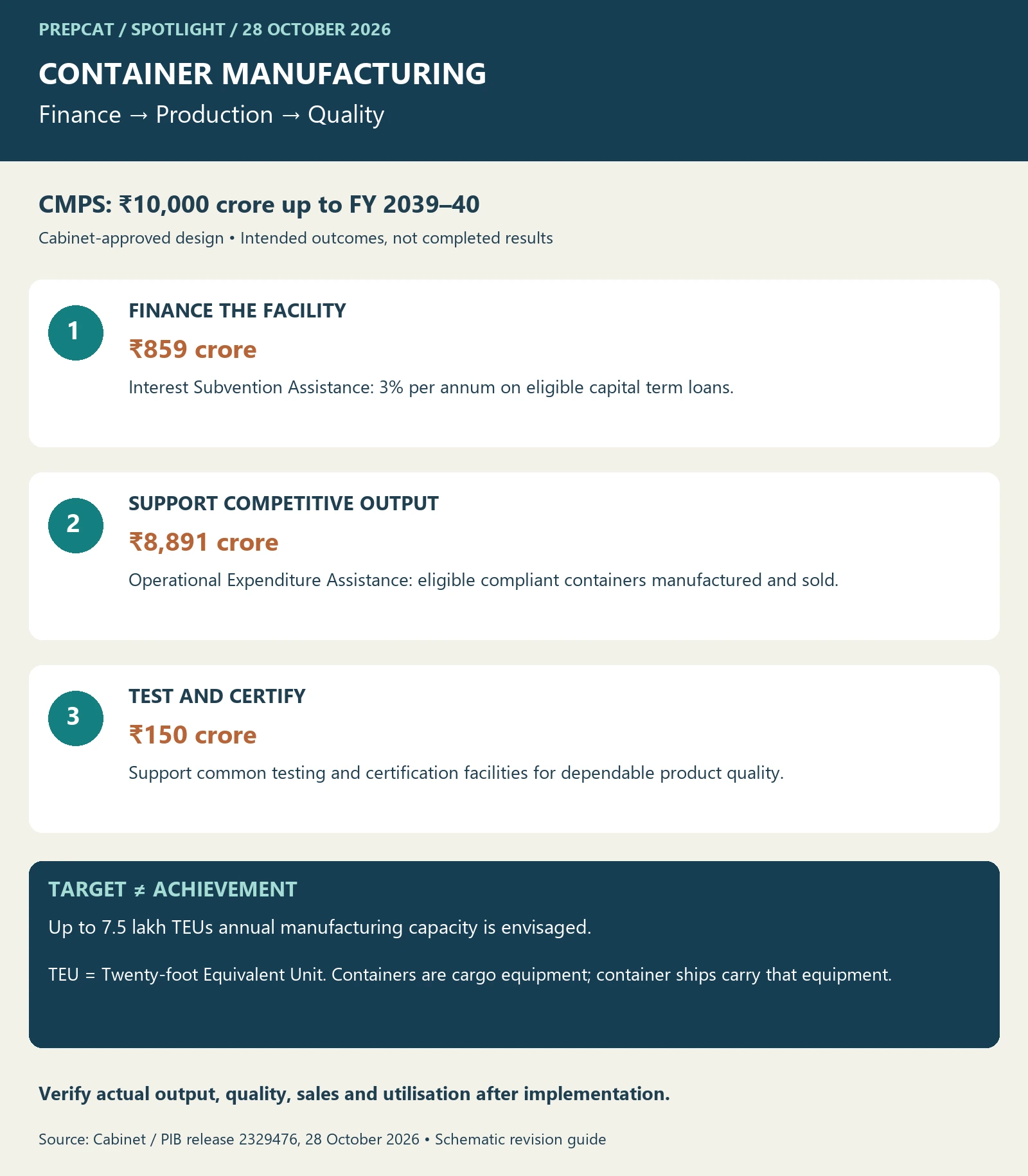
Latest Developments: On 28 October 2026, the Union Cabinet approved the Container Manufacturing Promotion Scheme, with a ₹10,000-crore outlay extending up to FY 2039–40. The approval supports new facilities and expansion of existing manufacturing. It sets out three components: ₹859 crore for interest subvention, ₹8,891 crore for operational expenditure assistance and ₹150 crore for testing and certification. Eligible capital loans receive 3% annual interest subvention under the stated scheme provision.
The approved release envisages annual capacity reaching up to 7.5 lakh TEUs. This is an intended result, not capacity already established. The older backgrounder used the name Container Manufacturing Assistance Scheme and a different presentation of duration. For the newly approved design, use the Cabinet release’s name, components and time horizon.
UPSC Prelims Pointers: Remember the sequence: finance the facility; improve operating competitiveness; demonstrate quality. Interest subvention reduces a specified borrowing cost—it is not the same as the government paying the whole investment. Operational assistance is tied to eligible containers manufactured to global shipping standards and sold. Testing infrastructure supports assurance rather than substituting for production.
How the Three Supports Address Different Problems
Investment stage: a manufacturer must commit to plant and equipment before sales arrive. Lower eligible financing costs can help with this initial barrier.
Production and sales stage: a factory must manage materials, labour, throughput and delivery. Assistance can bridge a cost gap, but durable competitiveness still requires productivity.
Assurance stage: customers need reliable performance across repeated handling and transport. Common testing can reduce duplication while allowing firms to demonstrate compliance.
What to Evaluate in Implementation
The following are analytical questions, not additional benefits promised by the approval. Are eligibility rules and claims transparent? Can smaller suppliers participate? Are payments timely? Does support result in additional competitive output, or primarily subsidise activity that would have occurred anyway?
Measure actual production, sales, quality and customer acceptance separately from installed capacity. A plant can exist without operating at full utilisation. Likewise, announced employment potential should be checked against sustained jobs and skills developed.
Environmental performance also deserves attention: efficient materials use, repairability and responsible end-of-life management can complement manufacturing growth. These require evidence; domestic origin alone is not a lifecycle sustainability assessment.
Revision Traps and a Quick Check
Do not mix up: containers and container ships; manufacturing capacity and port throughput; an outlay and money already disbursed; a projected result and an achieved result.
Check: Does the ₹10,000-crore approval mean that every listed facility is operational? No. Approval establishes policy support; implementation, production and verification follow through their own processes.
Sources
Cabinet approval, 28 October 2026; July commercial milestone; August backgrounder, read as historical context.
💭 Conclusion
CMPS seeks to connect financing, operating competitiveness and product assurance. Its success should be judged through additional competitive output, dependable quality and sustained supplier capabilities, while keeping approved support and projected capacity distinct from actual implementation.