
Current Affairs — 28 October 2026
Cyclone Arnab: landfall changes the response priority
WMO greenhouse-gas bulletin: concentration is not annual emissions
Disaster Divide: unequal exposure and recovery
HeatWatch stocktake: read the counting method
PM Viksit Gram Swaraj Yojana: local planning capacity
Sports goods manufacturing: clusters beyond athlete support
India–Mexico PTA: negotiations are launched
CBD COP17: four implementation publications
September IIP: new output data, not just rebasing
Punah Bharan: maps for groundwater recharge
GeM Samvad: procurement access and working capital
NHRC advisory: women prisoners and their children
Food colours: food-grade does not mean unrestricted
Arabian Black Electric Ray: deep-sea taxonomy
Immersive technologies: VR, AR and MR
Liechtenstein: investment engagement and a mapping link
Himachal tourism: carrying capacity before expansion
InvITs: connecting savings with infrastructure assets
IPO mechanics: fresh shares versus an offer for sale
Project Cheetah: protection beyond a park boundary
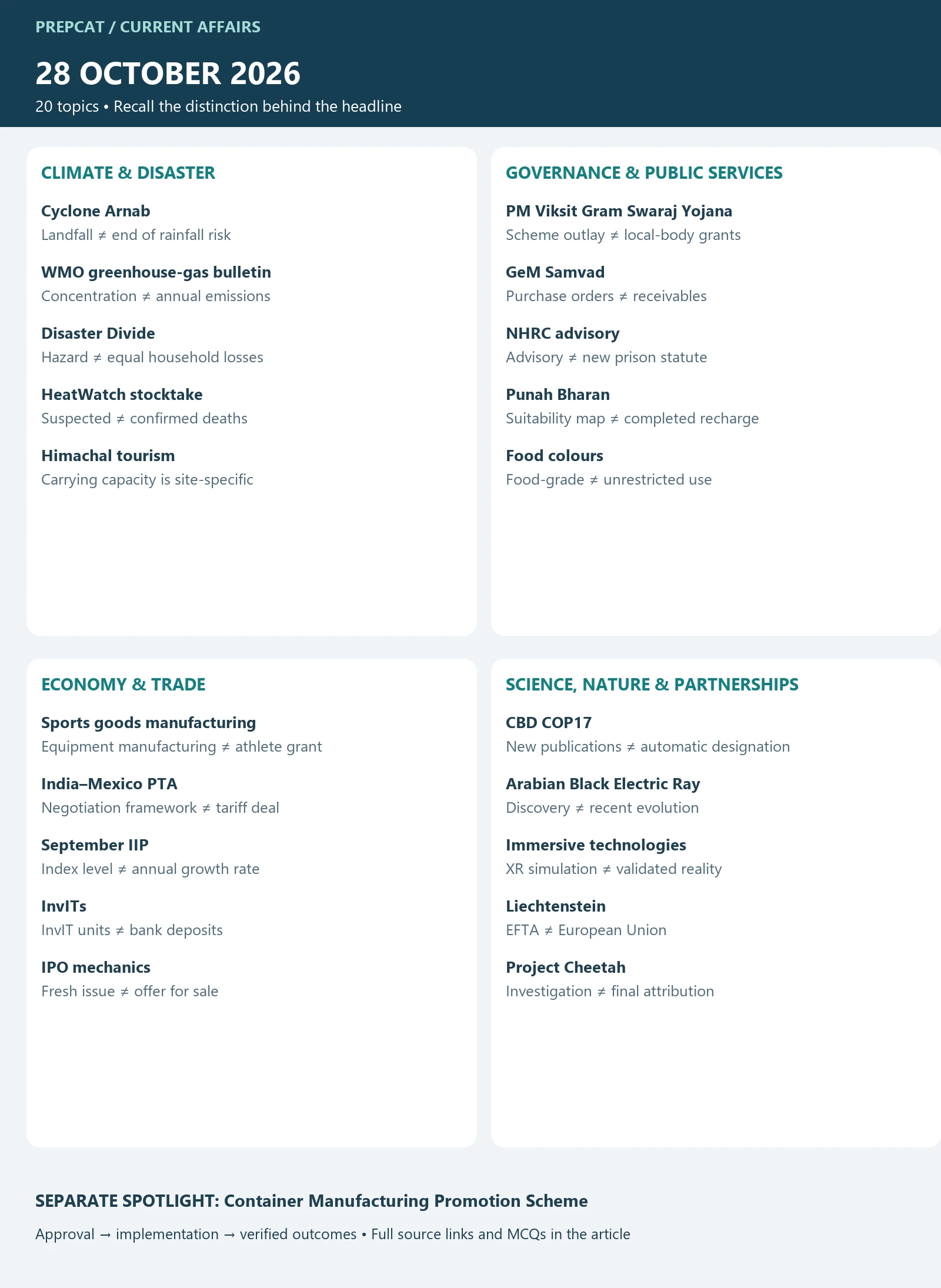
📌 Revision Pointers
Cyclone Arnab: Weakening wind intensity does not mean flood risk has ended. Evacuations, affected population and confirmed casualties are different measures.
WMO greenhouse-gas bulletin: Observation year: 2025; release year: 2026. 153% of a baseline means 53% above it. Do not confuse ppm with ppb.
Disaster Divide: Distinguish total emissions from per-person emissions, and consumption-related estimates from territorial accounts. A distributional study is not a forecast of a particular household’s loss.
HeatWatch stocktake: Report date and observation period differ. Suspected cases are not confirmed cases, while an incomplete observed count is not a modelled estimate of all excess deaths.
PM Viksit Gram Swaraj Yojana: eGramSwaraj supports planning; AuditOnline supports audit processes. The scheme outlay is different from Finance Commission grants to local bodies.
Sports goods manufacturing: This approval concerns the manufacturing ecosystem. Do not equate its total outlay with one year’s budget allocation or an athlete’s training grant.
India–Mexico PTA: The Terms of Reference establish the negotiation framework. They do not themselves introduce the final tariff concessions. Mexico is in North America.
CBD COP17: OECMs recognise effective area-based conservation outside conventional protected areas, subject to criteria. Cartagena concerns biosafety; Nagoya concerns access and benefit-sharing. Publication is not automatic designation of every candidate site.
September IIP: Reference month: September; release month: October. An index of 124.3 is not 124.3% annual growth. Use consistent series and distinguish year-on-year from month-on-month comparisons.
Punah Bharan: Inputs include rainfall, groundwater levels, yield, slope and drainage. A planning tool is not proof that groundwater has already been replenished or that every location is suitable.
GeM Samvad: GeM means Government e-Marketplace. TReDS discounts trade receivables. Registration or a financing facility is not a guaranteed contract, loan approval or timely payment.
NHRC advisory: This is an NHRC advisory and follow-up process, not a new parliamentary prison statute or proof of completed implementation. A recommendation differs from a binding judicial order.
Food colours: Do not infer that all synthetic colours are prohibited, or that every natural colour is permitted in every food. Avoid applying one numerical limit universally.
Arabian Black Electric Ray: Electric rays are cartilaginous fishes, not marine mammals. The Arabian Sea lies west of peninsular India. A new species description does not by itself establish an IUCN conservation category.
Immersive technologies: XR is an umbrella term. Hardware, connectivity, usable content, skills and privacy safeguards affect adoption. A convincing simulation still needs validation against the real system.
Liechtenstein: Liechtenstein is an EFTA member. Do not substitute the European Union for EFTA. The release describes the agreement’s investment aim, not a fresh claim that the full target has already arrived.
Himachal tourism: A committee recommendation is not an automatically operative nationwide rule. A local carrying-capacity study should examine infrastructure and ecological constraints together.
InvITs: InvIT units are not bank deposits. Distinguish InvITs from REITs, which focus on real estate. Regulation does not guarantee returns.
IPO mechanics: Fresh-issue proceeds go to the issuer; OFS proceeds go to selling holders, subject to offer expenses and terms. A large subscription does not guarantee future returns.
Project Cheetah: Kuno National Park is in Madhya Pradesh. An investigation is not a final attribution of criminal responsibility. Monitoring and survival are separate from simply counting animals released.
News date: 28 October 2026. Earlier releases are included where they form the day’s news discussion; observation periods and implementation stages are stated explicitly. The Container Manufacturing Promotion Scheme is covered separately in today’s Spotlight.
1. Cyclone Arnab: landfall changes the response priority (GS1 / GS3)
Basic Concept: A tropical cyclone combines intense winds, coastal surge and heavy rainfall. These hazards need separate assessments.
Core Context: The previous edition covered preparedness. Once a cyclone moves inland, river flooding, drainage failure and disruption of essential services may continue even as winds weaken.
Latest Developments: Down To Earth reported on 28 October that Arnab had completed landfall in Andhra Pradesh and weakened. Relief and damage assessment were continuing. Treat the report as a dated situation update, not the final disaster toll.
UPSC Prelims Pointers: Weakening wind intensity does not mean flood risk has ended. Evacuations, affected population and confirmed casualties are different measures.
Sources: 28 October landfall report.
2. WMO greenhouse-gas bulletin: concentration is not annual emissions (GS1 / GS3)
Basic Concept: Emissions are flows into the atmosphere; concentration describes the amount accumulated there. Natural sinks remove part of each year’s emissions.
Core Context: The warming effect depends on atmospheric accumulation and gas properties. A slower increase is still an increase, not a fall in the concentration.
Latest Developments: WMO’s 27 October release, covered by DTE on 28 October, reported globally averaged surface CO2 at 426.8 ppm in 2025, or 153% of the 1750 baseline. Methane and nitrous oxide also reached records.
UPSC Prelims Pointers: Observation year: 2025; release year: 2026. 153% of a baseline means 53% above it. Do not confuse ppm with ppb.
Sources: WMO bulletin release; DTE, 28 October.
3. Disaster Divide: unequal exposure and recovery (GS1 / GS3)
Basic Concept: Disaster risk reflects the hazard together with exposure, vulnerability and capacity to respond.
Core Context: Households facing the same flood can suffer different losses relative to income. Housing, savings, insurance and access to public services affect recovery.
Latest Developments: Oxfam’s Disaster Divide report was released on 27 October and discussed by DTE on 28 October. It argues that unequal emissions, vulnerability and recovery resources reinforce climate inequality. These are the report’s findings and policy arguments.
UPSC Prelims Pointers: Distinguish total emissions from per-person emissions, and consumption-related estimates from territorial accounts. A distributional study is not a forecast of a particular household’s loss.
Sources: Oxfam original report page; DTE coverage.
4. HeatWatch stocktake: read the counting method (GS2 / GS3)
Basic Concept: Surveillance records events using a case definition. A media-based tracker and an official clinical reporting system need not capture identical cases.
Core Context: Heat exposure is also a livelihood issue: outdoor workers may have limited ability to avoid dangerous conditions. Better data can inform local preparedness.
Latest Developments: HeatWatch’s 28 October stocktake recorded 359 media-reported heat-related deaths during March–July 2026: 86 classified as confirmed and 273 as suspected. This is the organisation’s news-tracker count, not an official all-India certified mortality total.
UPSC Prelims Pointers: Report date and observation period differ. Suspected cases are not confirmed cases, while an incomplete observed count is not a modelled estimate of all excess deaths.
Sources: HeatWatch report and definitions.
5. PM Viksit Gram Swaraj Yojana: local planning capacity (GS2)
Basic Concept: A Centrally Sponsored Scheme involves Union support and state participation; it differs from a fully Union-funded Central Sector scheme.
Core Context: Decentralised planning requires information, trained functionaries, public participation and accounting. A larger funding envelope alone does not ensure better village services.
Latest Developments: On 28 October, the Cabinet approved PM VGSY for 2026–27 to 2030–31, with an outlay of ₹7,395.55 crore, including Central and State shares. It supports planning, capacity building, digital systems and accountability across Panchayats and traditional rural local bodies.
UPSC Prelims Pointers: eGramSwaraj supports planning; AuditOnline supports audit processes. The scheme outlay is different from Finance Commission grants to local bodies.
Sources: Cabinet approval; Cross-check and background.
6. Sports goods manufacturing: clusters beyond athlete support (GS2 / GS3)
Basic Concept: A manufacturing cluster brings firms, suppliers and shared services together. Common testing and design facilities can reduce costs faced by individual enterprises.
Core Context: Sports participation and sports-equipment production are related but different policy areas. Competitive manufacturing also needs skills, certification and reliable market access.
Latest Developments: The Cabinet approved the Khelo India Sports Goods Manufacturing Scheme on 28 October, with ₹1,856.67 crore through 2033–34. It proposes manufacturing zones, investment and turnover-linked support, innovation, skilling and assistance for existing MSME clusters.
UPSC Prelims Pointers: This approval concerns the manufacturing ecosystem. Do not equate its total outlay with one year’s budget allocation or an athlete’s training grant.
Sources: Cabinet approval; Scheme cross-check.
7. India–Mexico PTA: negotiations are launched (GS2 / GS3)
Basic Concept: A Preferential Trade Agreement offers negotiated preferences. Rules of origin determine which goods qualify; customs procedures affect actual market access.
Core Context: Tariff concessions, standards and implementation all influence trade. Announcing talks is different from signing a completed agreement or putting it into force.
Latest Developments: On 28 October, India and Mexico announced signed Terms of Reference launching PTA negotiations. Areas include goods access, origin rules, customs, sanitary and phytosanitary measures, technical barriers and dispute settlement.
UPSC Prelims Pointers: The Terms of Reference establish the negotiation framework. They do not themselves introduce the final tariff concessions. Mexico is in North America.
Sources: Commerce Ministry release; Cross-check.
8. CBD COP17: four implementation publications (GS2 / GS3)
Basic Concept: Biodiversity policy combines conservation, sustainable use and benefit-sharing. Biosafety and access to genetic resources address different regulatory questions.
Core Context: The 27 October edition covered India’s national statement. The new development is a package of implementation references, not another account of that speech.
Latest Developments: At a 28 October side event in Yerevan, India released I-OECM designation guidelines, its fifth Cartagena biosafety report, a CBD handbook and an ABS success-story publication. The event stressed sustained outcomes and implementation capacity.
UPSC Prelims Pointers: OECMs recognise effective area-based conservation outside conventional protected areas, subject to criteria. Cartagena concerns biosafety; Nagoya concerns access and benefit-sharing. Publication is not automatic designation of every candidate site.
Sources: Environment Ministry release; Cross-check.
9. September IIP: new output data, not just rebasing (GS3)
Basic Concept: The Index of Industrial Production measures changes in industrial output relative to a base year. It is not an inflation index.
Core Context: The previous edition covered a state-level methodology workshop. This release supplies new all-India output estimates, a different development.
Latest Developments: MoSPI’s 28 October release reported September 2026 IIP growth of 6.7% year-on-year on the 2022–23 base. Manufacturing grew 7.6%. The headline index was 124.3 against 116.5 a year earlier. September figures are quick estimates subject to revision.
UPSC Prelims Pointers: Reference month: September; release month: October. An index of 124.3 is not 124.3% annual growth. Use consistent series and distinguish year-on-year from month-on-month comparisons.
Sources: MoSPI release and tables; Cross-check.
10. Punah Bharan: maps for groundwater recharge (GS1 / GS3)
Basic Concept: Artificial recharge guides water into aquifers using structures suited to local geology, terrain and water availability.
Core Context: A recharge structure must fit its site. Mapping can help prioritise investigations, but a digital suitability layer cannot replace field checking and water-quality assessment.
Latest Developments: On 28 October, the Jal Shakti Ministry launched Punah Bharan, developed by BISAG-N with the National Water Mission. The app identifies potential recharge zones within up to a 3 km radius; the portal offers village-level zonation and GIS layers.
UPSC Prelims Pointers: Inputs include rainfall, groundwater levels, yield, slope and drainage. A planning tool is not proof that groundwater has already been replenished or that every location is suitable.
Sources: Jal Shakti launch; Cross-check.
11. GeM Samvad: procurement access and working capital (GS2 / GS3)
Basic Concept: Public procurement is government purchasing. An online marketplace can simplify participation, while working-capital finance helps suppliers fulfil orders.
Core Context: A purchase order precedes supply; a receivable normally follows an invoice. Financing these stages addresses different business needs.
Latest Developments: The 28 October GeM Samvad release highlighted reduced participation costs, orders up to ₹10 lakh exempt from transaction charges and integration with TReDS exchanges. It also discussed GeM SAHAY lending against purchase orders. The event reviewed reforms; it did not establish that every measure began that day.
UPSC Prelims Pointers: GeM means Government e-Marketplace. TReDS discounts trade receivables. Registration or a financing facility is not a guaranteed contract, loan approval or timely payment.
Sources: GeM Samvad release; Cross-check.
12. NHRC advisory: women prisoners and their children (GS2 / GS4)
Basic Concept: A rights-based custodial system must protect dignity, healthcare, access to justice and children’s interests.
Core Context: A child living with a detained parent has independent welfare needs. Custodial administration must distinguish confinement of the parent from punishment of the child.
Latest Developments: A 28 October NHRC release announced an advisory covering maternal and child healthcare, records, family contact, legal aid, living conditions and rehabilitation. It sought action-taken reports within two months from concerned authorities.
UPSC Prelims Pointers: This is an NHRC advisory and follow-up process, not a new parliamentary prison statute or proof of completed implementation. A recommendation differs from a binding judicial order.
Sources: NHRC release; Cross-check.
13. Food colours: food-grade does not mean unrestricted (GS2 / GS3)
Basic Concept: A food additive must be permitted for its particular use and comply with relevant conditions. Industrial dyes are not interchangeable with food colours.
Core Context: Enforcement must address product categories, quantities, sourcing and records. Visual appeal alone cannot establish food safety.
Latest Developments: An Indian Express explainer updated on 27 October and included in the 28 October study cycle examined Uttar Pradesh’s scrutiny of food colours. It highlighted prohibited industrial dyes such as Rhodamine B and category-specific controls even for permitted additives.
UPSC Prelims Pointers: Do not infer that all synthetic colours are prohibited, or that every natural colour is permitted in every food. Avoid applying one numerical limit universally.
Sources: Dated explainer; FSSAI analytical manual: permitted versus unpermitted dyes.
14. Arabian Black Electric Ray: deep-sea taxonomy (GS3)
Basic Concept: Taxonomy identifies and classifies organisms. Scientists can combine anatomical characters with DNA evidence to distinguish closely related species.
Core Context: Species discovery reveals gaps in marine surveys. Discovering a species does not mean it has only just evolved, nor establish its abundance or conservation status.
Latest Developments: ZSI’s new Arabian Sea electric-ray discovery was reported on 27 October and featured in the 28 October roundup cycle. Reports identify Tetronarce ramanamurthyi from waters off southwestern India, with research under the Deep Ocean Mission.
UPSC Prelims Pointers: Electric rays are cartilaginous fishes, not marine mammals. The Arabian Sea lies west of peninsular India. A new species description does not by itself establish an IUCN conservation category.
Sources: PTI report of ZSI statement; Independent spelling and discovery cross-check.
15. Immersive technologies: VR, AR and MR (GS3)
Basic Concept: Virtual reality replaces the viewed environment with a simulation; augmented reality adds digital elements to the physical view. Mixed reality enables richer interaction between physical and digital elements.
Core Context: Training simulations, heritage interpretation and spatial planning can use these tools. Digital twins are models of real systems; they are not synonymous with headsets.
Latest Developments: InsightsIAS’s 28 October edition revisited immersive technologies and India’s creative-technology ecosystem. The study relevance is the distinction between tools, applications and adoption constraints, rather than an assumption that every proposed laboratory or market forecast is already realised.
UPSC Prelims Pointers: XR is an umbrella term. Hardware, connectivity, usable content, skills and privacy safeguards affect adoption. A convincing simulation still needs validation against the real system.
Sources: 28 October technology explainer.
16. Liechtenstein: investment engagement and a mapping link (GS1 / GS2 / GS3)
Basic Concept: A trade agreement creates a framework; actual investment depends on business decisions and implementation. A commitment or target is not a realised flow.
Core Context: Smaller European economies can have specialised manufacturing strengths. Geography and institutional membership help interpret their role in trade partnerships.
Latest Developments: India’s Commerce Ministry reported a meeting with Liechtenstein’s Hereditary Prince Alois on 28 October, focused on economic engagement and opportunities under India–EFTA TEPA, including precision engineering and advanced manufacturing.
UPSC Prelims Pointers: Liechtenstein is an EFTA member. Do not substitute the European Union for EFTA. The release describes the agreement’s investment aim, not a fresh claim that the full target has already arrived.
Sources: Commerce Ministry meeting; Mapping and current-affairs cross-check.
17. Himachal tourism: carrying capacity before expansion (GS1 / GS3)
Basic Concept: Carrying capacity is the level of use compatible with defined ecological and service limits. It depends on local conditions and management choices.
Core Context: Hill destinations need water, waste services, road safety and slope stability as well as accommodation. Visitor totals alone cannot measure sustainability.
Latest Developments: The 28 October newspaper sweep covered Central Empowered Committee recommendations for Himachal Pradesh, including carrying-capacity studies and risk-sensitive planning. The Indian Express reported that the state was given time to respond to the recommendations.
UPSC Prelims Pointers: A committee recommendation is not an automatically operative nationwide rule. A local carrying-capacity study should examine infrastructure and ecological constraints together.
Sources: Committee recommendations; 28 October GS-tagged newspaper sweep.
18. InvITs: connecting savings with infrastructure assets (GS3)
Basic Concept: An Infrastructure Investment Trust pools funds through units and invests in infrastructure assets, directly or through permitted structures.
Core Context: Operating infrastructure can generate cash flows, while investors bear relevant business and market risks. Asset ownership, investment management and project operations have distinct roles.
Latest Developments: NextIAS’s 28 October newspaper sweep highlighted reporting on InvITs seeking household savings. SEBI’s investor material explains the underlying pooling structure and infrastructure focus. This is a financing-theme update, not a recommendation to buy a particular security.
UPSC Prelims Pointers: InvIT units are not bank deposits. Distinguish InvITs from REITs, which focus on real estate. Regulation does not guarantee returns.
Sources: Dated newspaper theme; SEBI explanation; SEBI structural FAQ.
19. IPO mechanics: fresh shares versus an offer for sale (GS3)
Basic Concept: An IPO is an initial public offering of equity. A fresh issue creates shares; an offer for sale sells existing holders’ shares.
Core Context: These components have different recipients of proceeds. Stock-market listing and subsequent trading are also distinct from the initial public offer.
Latest Developments: The 28 October InsightsIAS edition used IPOs as a Prelims topic amid listing coverage. The key economic distinction is whether an offering raises fresh capital for the company or enables existing holders to sell their shares.
UPSC Prelims Pointers: Fresh-issue proceeds go to the issuer; OFS proceeds go to selling holders, subject to offer expenses and terms. A large subscription does not guarantee future returns.
Sources: Dated study topic; NSE IPO explanation.
20. Project Cheetah: protection beyond a park boundary (GS3)
Basic Concept: Reintroduction requires continuing monitoring, habitat management and protection across the landscape used by released animals.
Core Context: Animals may move beyond protected-area boundaries. Conservation therefore depends on field coordination and responding to risks outside a fenced or notified site.
Latest Developments: On 28 October, MoEFCC announced a central investigation after a young male cheetah died on 27 October from firearm-pellet injuries. The team includes NTCA and WCCB officials and will coordinate with Madhya Pradesh authorities.
UPSC Prelims Pointers: Kuno National Park is in Madhya Pradesh. An investigation is not a final attribution of criminal responsibility. Monitoring and survival are separate from simply counting animals released.
Sources: Environment Ministry investigation release; DTE cross-check.
Practice MCQs
Original statement-based practice questions; not previous-year UPSC questions.
Q1. Consider the following statements about greenhouse-gas reporting:
Concentration describes accumulated gas in the atmosphere.
A value of 153% of the baseline means 153% above the baseline.
Which of the statements given above is/are correct?
(A) 1 only
(B) 2 only
(C) Both 1 and 2
(D) Neither 1 nor 2
Answer: (A) 1 only
Explanation: The first statement is correct. 153% of a baseline is 53% above it; emissions and atmospheric concentrations measure different things.
Q2. With reference to trade negotiations, consider the following statements:
Terms of Reference can establish the scope and roadmap for negotiations.
Signing Terms of Reference necessarily puts the final tariff concessions into force.
Which of the statements given above is/are correct?
(A) 1 only
(B) 2 only
(C) Both 1 and 2
(D) Neither 1 nor 2
Answer: (A) 1 only
Explanation: A negotiation framework is different from a completed agreement and its entry into force.
Q3. Consider the following statements about IIP:
An index level of 124.3 necessarily means 124.3% annual growth.
Quick estimates may be revised when more data arrive.
Which of the statements given above is/are correct?
(A) 1 only
(B) 2 only
(C) Both 1 and 2
(D) Neither 1 nor 2
Answer: (B) 2 only
Explanation: An index level is relative to its base; year-on-year growth compares corresponding periods. Quick estimates remain revisable.
Q4. With reference to biodiversity institutions, consider the following statements:
Cartagena addresses biosafety.
OECMs are automatically identical to formally notified protected areas.
Which of the statements given above is/are correct?
(A) 1 only
(B) 2 only
(C) Both 1 and 2
(D) Neither 1 nor 2
Answer: (A) 1 only
Explanation: Cartagena concerns biosafety. OECMs recognise qualifying conservation outcomes outside conventional protected-area arrangements.
Q5. Consider the following statements about digital recharge planning:
Local terrain and groundwater conditions influence recharge suitability.
A suitability map alone proves that groundwater recharge has already occurred.
Which of the statements given above is/are correct?
(A) 1 only
(B) 2 only
(C) Both 1 and 2
(D) Neither 1 nor 2
Answer: (A) 1 only
Explanation: Maps support selection and investigation. Successful recharge requires appropriate design, implementation, water quality and monitoring.
Q6. Consider the following statements about food colours:
A permitted additive may still have food-category restrictions.
Food-grade status permits unrestricted use in every food.
Which of the statements given above is/are correct?
(A) 1 only
(B) 2 only
(C) Both 1 and 2
(D) Neither 1 nor 2
Answer: (A) 1 only
Explanation: Permission is conditional on the relevant category and requirements. Industrial dyes are not interchangeable with food additives.
Q7. Consider the following statements about capital markets:
An offer for sale involves existing holders selling shares.
InvIT units are equivalent to guaranteed bank deposits.
Which of the statements given above is/are correct?
(A) 1 only
(B) 2 only
(C) Both 1 and 2
(D) Neither 1 nor 2
Answer: (A) 1 only
Explanation: OFS proceeds accrue to the selling holders under the offer terms. InvITs are market-linked infrastructure investment vehicles, not guaranteed deposits.
💭 Conclusion
Revise the mechanism behind each headline, then check its date and evidence status. The day connects local governance, industrial policy, public health, conservation and climate risk. Use the chart for recall and the statement questions to test distinctions between proposals, reported findings and completed outcomes.